Detmold is a city with a population of 73,368 in North Rhine-Westphalia, Germany. It is the capital of the administrative district (Regierungsbezirk) of the same name and of the Lippe district (Kreis) (license plate LIP).
Detmold holds the title of “Large District City” (Große kreisangehörige Stadt). The town lies on the banks of the Werra, a tributary of the Weser, in a picturesque, densely forested region. Until 1918, it was the capital of the Principality of Lippe, whose origins date back to the 12th century.
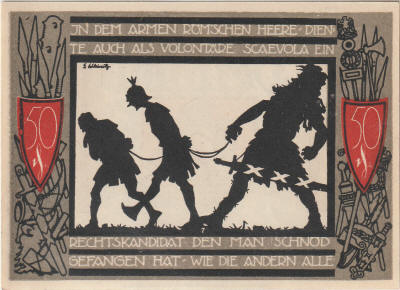
Previous Page Description This set of 10 banknotes was issued by the city of Detmold in denominations of 50 Pfennig in 1920. The design on the front of the banknote features a castle tower in the center, along with the denomination and text in German. On the back of the note are stylized figures of a knight and soldiers. The note contains no security threads or watermarks and measures 95 x 68 mm. The History: This series tells the story of the Battle of the Teutoburg Forest, known as the Clades Variana (“the defeat of Varus”) by Roman historians, which took place in the year 9 between the Roman army led by Publius Quintilius Varus and a coalition of Germanic tribes commanded by Arminius, an officer in Varus’s auxiliary troops but also, secretly, the leader of the Cherusci. The battle took place near the present-day town of Kalkriese, in Lower Saxony, and resulted in one of the most severe defeats suffered by the Romans: three entire legions (the 17th, 18th, and 19th) were annihilated, along with 6 infantry cohorts and 3 wings of auxiliary cavalry. Only seven years later did the imperial legate Germanicus manage to defeat Arminius in two major battles: the first on the plain of Idistaviso, the second in front of the Angrivarian Wall, both between the right bank of the Visurgi River (today’s Weser), the surrounding hills, the great Germanic forest, and the marshes further to the north. Note 1: The Romans’ initiative drove them into northern Germany. General Quintilius Varus rode at the head of the army to the sound of trumpets. Note 2: But in the Teutoburg Forest, how the north wind blew and how the horns sounded; crows flew through the air, and there was a smell—like that of blood and corpses. Note 3: Suddenly, from outside the Duster Forest, the Cherusci burst forth, wildly chanting praises to God, the king, and the fatherland, and, enraged, threw themselves upon the legions. Note 4: Alas, it was a great massacre. They slaughtered the cohorts. Only the Roman cavalry managed, in part, to escape into the open because they were on horseback. Note 5: Oh, Quintilius! Wretched general, don’t you know that this is the fate of all our men? He fell in a swamp—how devastating! He lost two cohorts, the left wing of the cavalry, and in the end was overwhelmed. Note 6: Then he said, full of rage, to Centurion Titiussen, “Comrade, draw your sword and stab me in the back, for all is lost.” Note 7: In the Roman army, as a volunteer; he was a law student and was immediately captured, like all the others. Note 8: When the massacre ended, Prince Hermann rubbed his hands together and, to make himself even happier, invited the Cherusci to a lavish lunch. Note 9: Only in Rome were people not rejoicing; instead, they were buying mourning clothes. Just as Augustus was seated at noon in the emperor’s hall, the news of the tragedy arrived. Note 10: And in honor of this battle, a monument was erected. Germany’s strength and unity are now proclaimed far and wide—let them come!
This set of 10 banknotes was issued by the city of Detmold in denominations of 50 Pfennig in 1920. The design on the front of the banknote features a castle tower in the center, along with the denomination and text in German. On the back of the note are stylized figures of a knight and soldiers. The note contains no security threads or watermarks and measures 95 x 68 mm.
The story:
This series tells the story of the Battle of the Teutoburg Forest, known as the *Clades Variana* (“the defeat of Varus”) by Roman historians, which took place in the year 9 between the Roman army led by Publius Quintilius Varus and a coalition of Germanic tribes commanded by Arminius, an officer in Varus’s auxiliary forces, but also secretly the leader of the Cherusci.
The battle took place near the present-day town of Kalkriese, in Lower Saxony, and resulted in one of the most severe defeats suffered by the Romans: three entire legions (the 17th, 18th, and 19th) were wiped out, along with 6 infantry cohorts and 3 wings of auxiliary cavalry.
Just seven years later, the Germanic imperial legate managed to defeat Arminius in two major battles: the first on the plain of Idistaviso, the second in front of the Angrivarian Wall, both between the right bank of the Visurgi River (now the Weser), the surrounding hills, the great Germanic forest, and the marshes further to the north.
Note 1: The Romans’ resourcefulness led them to the north of Germany. General Quintilius Varus rode at the head of the army to the sound of trumpets.
Note 2: But in the Teutoburg Forest, how the north wind blew and how the horn sounded; crows flew through the air, and there was a smell—like blood and corpses.
Note 3: Suddenly, outside the Duster Forest, the Cherusci broke out in frenzied cheers praising God, the king, and the fatherland, and, enraged, threw themselves at the legions.
Note 4: Alas, it was a terrible massacre. They wiped out the cohorts. Only the Roman cavalry managed, to some extent, to escape into the open because they were on horseback.
Note 5: Oh, Quintilius! Wretched general, don’t you know that all our men are like this? He fell into a swamp—how devastating! He lost two cohorts and the left wing of the cavalry, and in the end he was suffocated.
Note 6: Then he said, filled with rage, to the centurion Titiussen, “Comrade, draw your sword and stab me in the back, for all is lost.”
Note 7: In the Roman army, the poor Scaevola served as a volunteer; he was a law student and was immediately captured, just like everyone else.
Note 8: When the massacre ended Prince Hermann rubbed his hands together and, to make himself even happier, invited the Cherusci to a lavish lunch.
Note 9: Only in Rome were the people not in high spirits; instead, they were buying mourning clothes. Just as Augustus was sitting in the Emperor’s Hall at noon, the news of the death arrived.
Note 10: And in honor of this battle, a monument was erected. Germany's strength and unity are now proclaimed far and wide—let them come!