Quedlinburg (Queddelnborg in Low German) is a German city with a population of 23,798 located in the state of Saxony-Anhalt.
It is part of the Harz district (license plate code HZ).
Until July 1, 2007, it was the seat of the district of the same name.
The city of Quedlinburg has existed since at least the early 10th century, when a settlement known as Gross Orden on the eastern bank of the Bode River was first mentioned.
Its name first appears in writing in 922 as part of a donation by Henry I the Fowler, and is preserved at Corvey Abbey.
The Quedlinburg complex, founded by Henry I and expanded by Otto I the Great, was an imperial palatinate of the Saxon emperors.
During the Nazi regime, the memory of Henry I the Fowler became almost a cult, as Heinrich Himmler saw himself as the reincarnation of the “most German of German rulers.”
The church in Quedlinburg and the castle became a sort of sanctuary for Nazi Germany. In the 1980s, Polish specialists were brought in to restore the city's historic architecture.
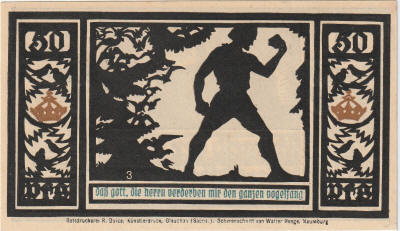
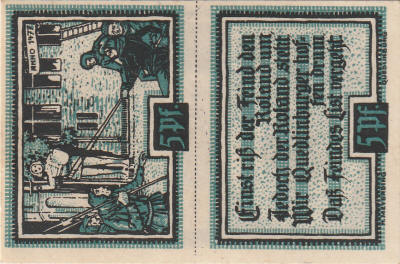
Previous Page Description This series depicts the epic story of King Henry I. He was the king who subjugated Quedlinburg; here he is depicted presenting a document in the town square in the year 919. The images on the various banknotes refer to the proclamation of the power of the German Reich. In 919, the Duke of Saxony, Heinrich von den Franken, was crowned king. His predecessor, Konrad I, had died on December 23, 918. He was notified of his coronation through the document depicted on the banknote, which was presented to him in the town square of Quedlinburg. Other cities also claim this event as their own. King Heinrich I was given the nickname “Vogler” (the Mad), and in fact, many poems and lyrical works refer to this figure. The reverse side of the banknotes shows the large castle with a roof and towers that were modified in 1945 and given a simpler design. The face value of each banknote is the same as that of the first series, namely 50 pfennig
This series depicts the epic life of King Heinrich I.
He was the king who conquered Quedlinburg; he is depicted here presenting a document in the town square in the year 919.
The images on the various banknotes depict the proclamation of the German Reich's power.
In 919, Heinrich von den Franken, Duke of Saxony, was crowned king. His predecessor, Conrad I, had died on December 23, 918. He was notified of his coronation through the document depicted on the banknote, which was presented to him in the town square of Quedlinburg.
Other cities are vying for ownership of this event.
King Heinrich I was given the nickname "Vogler" (the Mad), and in fact, many poems and lyrical works refer to this figure.
The backs of the banknotes show the large castle with a roof and towers that were modified in 1945 and redesigned in a simpler style.
The face value of each banknote is the same as that of the first series, namely 50 pfennig